Pakistan Says 6-7 Muslim Nations Want To Join Mecca Joint Defence Agreement Amid Iran War: Report
Pakistan says six to seven Muslim-majority countries are interested in joining the Makkah Joint Defence Agreement signed by Pakistan, Saudi Arabia and Turkiye. The development comes as the three countries begin formal defence coordination in Istanbul amid the Israel-Iran conflict, heightened Gulf tensions and uncertainty over shipping through the strategically important Strait of Hormuz.

Pakistan has revealed that six to seven Muslim-majority countries are showing interest in joining the Mecca Joint Defence Agreement, as Saudi Arabia, Pakistan and Turkiye move to strengthen military coordination amid continuing regional tensions. The development was discussed during talks in Istanbul involving senior diplomats and defence officials from the three signatories.
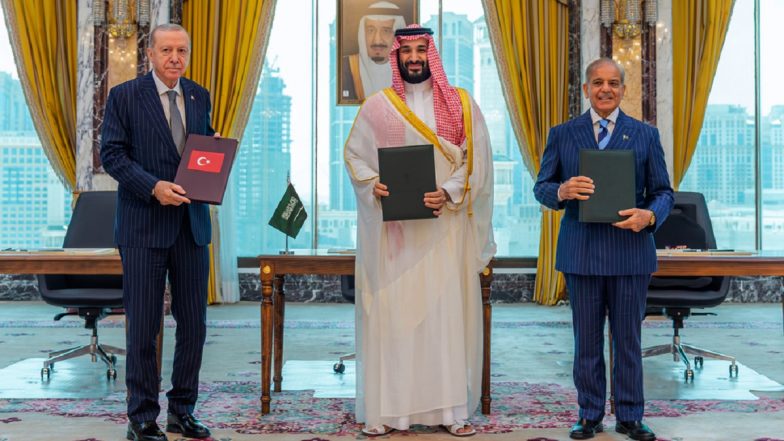
The Makkah Joint Defence Agreement was signed by Pakistan, Saudi Arabia and Turkiye in Makkah on August 7. The pact is designed to strengthen collective deterrence and states that an armed attack against any one of the three countries shall be regarded as an attack against all. Pakistan has described the agreement as defensive in nature and said it is open to other regional countries that support its principles. Did Iran Target Al Minhad Air Base? UAE Denies Reports of Attack.
Six To Seven Countries Show Interest
Pakistan's latest announcement suggests that the agreement could expand beyond its original three members, Bloomberg reported. The interest comes as the signatories begin moving from the political announcement of the pact towards formal defence coordination. The first meeting of the Strategic Political and Defence Committee established under the agreement is being held in Istanbul on August 31.
Pakistan is represented at the meeting by Deputy Prime Minister and Foreign Minister Ishaq Dar, Defence Minister Khawaja Asif and Chief of Defence Forces and Army Chief Field Marshal Asim Munir. Foreign and defence ministers and military chiefs from Turkiye and Saudi Arabia are also attending. Mecca Joint Defense Agreement: Pakistan Says Saudi-Turkey Pact Is ‘Purely Defensive’, Not Against Any Nation.
What Is The Makkah Defence Agreement?
The agreement was signed by Saudi Crown Prince Mohammed bin Salman, Turkish President Recep Tayyip Erdogan and Pakistani Prime Minister Shehbaz Sharif. It stipulates that an armed attack against any one of the three countries will be regarded as an attack against all. The agreement also calls for broader defence cooperation and stronger collective deterrence.
Pakistan has said the pact is “purely” defensive in nature and is not directed against any country. Foreign Minister Ishaq Dar has said the agreement remains open to countries willing to uphold its principles and resolve differences through “mutual respect, cooperation and peaceful means.”
Turkish President Recep Tayyip Erdogan has similarly said the agreement does not target any country and is open to other friendly nations seeking peace, prosperity and stability in the region.
The possible expansion of the pact comes against the backdrop of heightened tensions in the Middle East and the continuing conflict involving Iran, Israel and the United States. The security situation has also raised concerns over the Strait of Hormuz, a crucial route for global oil shipments. Any prolonged disruption to shipping through the waterway could have wider consequences for energy markets and regional economies.
Market pricing cited in the supplied report puts the probability of traffic returning to normal in the Strait of Hormuz by December 31 at 28.5% YES. That figure reflects market expectations rather than an official forecast.
The addition of more countries could give the Makkah agreement greater regional reach and potentially increase coordination in areas such as defence planning, intelligence, military cooperation and security.
However, interest from prospective members does not necessarily mean that they have formally decided to join. Official confirmation from each country would be required before any expansion can be considered final. Bangladesh, for example, has already indicated that it is considering joining the pact, while maintaining that participation would not prevent it from maintaining other international partnerships.
The immediate focus will be on the outcome of the Istanbul meeting and whether the participating countries provide details on how the agreement's defence mechanisms will be implemented.
Further announcements from countries reportedly interested in joining will also be important. Their decisions could determine whether the agreement remains a trilateral arrangement or develops into a broader regional security framework.
Observers will also be watching reactions from Iran and the United States, whose policies and responses could influence the wider security environment around the Gulf and the Strait of Hormuz.
(The above story first appeared on LatestLY on Aug 31, 2026 04:07 PM IST. For more news and updates on politics, world, sports, entertainment and lifestyle, log on to our website latestly.com).