US-Iran War: JD Vance Says Conflict Will Enter ‘Much Different Phase’ Midterm Elections
US Vice President JD Vance says the conflict with Iran will enter a 'much different phase in a couple of months,' echoing President Donald Trump’s prediction that the war could end after the November midterms. Vance said US operations have shifted while Iran continues attacks on shipping, as Washington works to reopen the Strait of Hormuz and prevent Tehran from rebuilding.

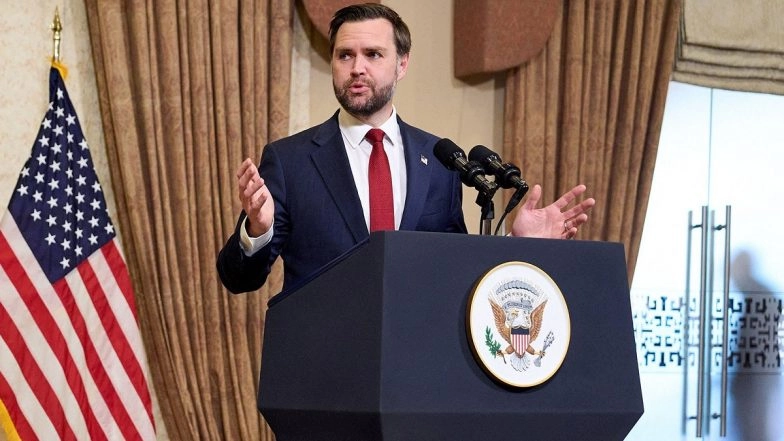
US Vice President JD Vance says the conflict between the United States and Iran will enter a “much different phase in a couple of months,” echoing President Donald Trump’s prediction that the fighting could end shortly after the November midterm elections. Vance said the United States is no longer conducting aggressive operations, while Iran continues intermittent attacks on commercial shipping in the Strait of Hormuz.
The comments come as Washington continues efforts to restore traffic through the strategic waterway, where shipping remains well below pre-war levels. The conflict, now in its seventh month, has also imposed significant financial and military costs on the United States, with the Congressional Budget Office estimating that the war had cost the Pentagon more than USD 38 billion through August 1. Donald Trump Says Iran War To End After US Midterm Elections.
Vance Signals A New Phase In The Conflict
The US conflict with Iran will enter a “much different phase in a couple of months,” Vice President JD Vance told The Post in an exclusive interview, agreeing with the president that the war would conclude “right after” the midterms following months of tit-for-tat strikes between Washington and Tehran.
The vice president said in a sit-down aboard Air Force Two on Monday that the Iranian regime would continue to lose control over the Strait of Hormuz until the election, now that the critical global energy chokepoint has “returned to well over 50% of normal traffic.” Donald Trump Warns US Could Strike Iran’s Deeply Buried ‘Pickaxe Mountain’ Nuclear Facility.
“We can’t predict the future, but I think the president is right to say that this thing will enter a much different phase in a couple of months,” Vance said. “He’s also the commander in chief, so he’s the person who determines … when conflicts start and when they stop.”
“I certainly understand there’s some impatience from the American people, but fundamentally what’s happening right now is that the United States is not engaged in aggressive operations. We’re just not,” he added. “But what is happening is that the Iranians are occasionally shooting at commercial shipping, usually not successfully,” Vance said.
Vance's latest remarks represent a shift in tone from comments he made earlier in September, when he declined to provide a timeline for the conflict's end. At the time, he said he did not know when Iran would stop attacking ships and argued that major US combat operations had already ended.
Strait Of Hormuz Remains A Key Flashpoint
Navy SEALS have de-mined much of the strait in the past four months, but crossings remain far below their pre-war levels. Just 11 commercial vessels transited the strait in the last 24 hours, according to shipping trackers, whereas on average 130 crossed the waterway between Oman and Iran before the war.
However, for months the US has quietly escorted commercial oil tankers with their transponders turned off to evade attacks from Iran, and these so-called “dark” missions are not easily tracked by public numbers. Roughly 20% of the world’s seaborne oil flows through Hormuz.
The United States has made progress reopening the waterway, but traffic remains constrained. The US Energy Information Administration has projected that flows through the strait will remain below normal through the end of 2026, with pre-war levels not expected to return until the second quarter of 2027 under its current outlook.
The importance of Hormuz extends beyond the immediate US-Iran confrontation. The waterway is a major route for global oil shipments, meaning prolonged disruption can affect energy prices and inflation well beyond the Middle East.
US And Iran Continue To Exchange Attacks
The US has degraded most of Iran’s missile and drone capabilities, but Tehran is also still intermittently striking commercial vessels in the strait and launching attacks on American military bases in the Middle East. Gulf allies have also been targeted, with Trump recently suggesting last weekend that damage to Saudi Arabia’s East-West oil pipeline was caused by Iranian drones.
American forces have also targeted Iranian oil tankers, while the US Treasury has sanctioned banks and other entities keeping the regime’s war machine afloat financially. Recent incidents underline the continuing risk around Hormuz. US forces destroyed two Iranian small boats on Monday after they attempted to seize a US Navy unmanned vessel patrolling the strait, according to US officials and Iranian media.
The confrontation has also affected energy markets. Brent crude recently moved above USD 100 a barrel for the first time since July as attacks and disruptions around regional shipping routes raised concerns about supplies.
Washington Says 1st Phase Is Complete
“There are really two phases to this thing, and the first phase is done,” Vance continued. “The first phase was destroy the nuclear program, destroy their conventional military, destroy their ability to project power in a way that they were able to even a couple of years ago.”
“And then the second phase of this is ensure that they’re not able to rebuild and try to maintain as much global stability in the wake of that,” he also said. The comments outline what Vance described as a transition from destroying Iranian military and nuclear capabilities to preventing Tehran from rebuilding them.
The Congressional Budget Office has estimated that the conflict has already cost the US Department of Defense more than USD 38 billion, with ongoing costs potentially reaching about USD 3 billion a month depending on the intensity of military operations. The CBO also said the war has put pressure on US munitions stocks and could have broader economic effects.
Cease-Fire Efforts And Nuclear Talks
Vance had been the architect of a Memorandum of Understanding in mid-June between the US and Iran that initiated a cease-fire to pursue negotiations over Tehran’s nuclear program and wind down the conflict. Those diplomatic efforts have not produced a lasting settlement. Earlier this month, Vance said negotiations were on hold until Iran stopped attacking commercial shipping.
The Trump administration has continued to combine military pressure with economic measures, including sanctions targeting Iranian financial networks and efforts to restrict Tehran's oil revenues.
What Happens After The Midterms?
It’s unclear whether Trump will ramp up attacks after the midterm elections to finish the job, or find that Iran is more agreeable to make a deal. Trump told reporters last Wednesday before heading to the Republican midterm convention in Dallas that “right after the election, oil prices are going to be tumbling downward.”
“I think the war will end immediately after the election because they can’t hold out any longer,” he added. Trump made similar comments on September 9, saying he expected the conflict to end immediately after the election and arguing that Iran could not withstand continued US economic pressure. He also acknowledged that negotiations remained possible, although he said they were not the administration's preferred approach at that point.
Vance's latest comments stop short of guaranteeing that the fighting will end after the election. Instead, he said the conflict would enter a “much different phase,” leaving open the possibility of continued military, economic or diplomatic pressure after November. That uncertainty is also reflected in recent reporting that some senior administration officials have privately considered the possibility that the conflict could last considerably longer than Trump's public timeline.
DISCLAIMER: This article is strictly for informational and educational purposes to raise awareness about the said topic. LatestLY DO NOT host, distribute, or provide links to sexually explicit content, leaked videos, or pirated material. Any search terms or keywords mentioned are solely for the purpose of explaining the viral trend and its associated dangers. We strongly condemn the circulation of non-consensual intimate imagery (NCII) and advise all readers to refrain from searching for or sharing such content, as doing so may lead to severe legal consequences.
(The above story first appeared on LatestLY on Sep 16, 2026 07:58 AM IST. For more news and updates on politics, world, sports, entertainment and lifestyle, log on to our website latestly.com).