













 Quickly
 Socially
 Trending
 Crypto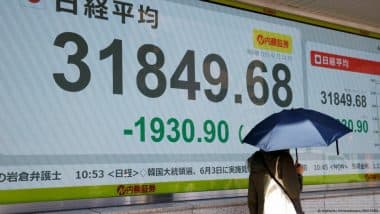
Global markets from Europe to Asia have continued to feel the pain of Donald Trump's tariffs. The US president has shown no sign of reconsidering despite the economic turmoil. DW has the latest.
Germany's DAX index falls nearly 10% at opening on MondayAlso Read | India Retaliates After Pakistani Army Violates Ceasefire on LoC in Jammu and Kashmir's Poonch District.
Key stock markets in Asia have continued to fall
US stock markets are also expecting further losses on MondayAlso Read | School Job Case: West Bengal CM Mamata Banerjee To Meet Thousands of Sacked Teachers After Supreme Court Verdict.
EU trade ministers are meeting to discuss how to respond to Trump's 20% tariffs
US President Donald Trump has shown no signs of backing down, calling the global economic turmoil a necessary 'medicine'
Here are the latest developments from the fallout of the Trump tariffs on Monday, April 7:
Germany's leading DAX index leads in European losses on Monday
The German DAX index dropped by nearly 10% on Monday morning as stock markets opened, before recovering slightly to hover around 7% in the red as trading continued.
The tumble follows days of volatility in global markets sparked by Trump's tariffs.
A 20% tariff against most EU imports to the US is set to come into effect on Wednesday.
Indexes in other European countries were also in freefall on Monday morning.
Paris saw a more than 6% drop, while in London it was just under 6%. Losses of more than 5% were seen in Amsterdam and Oslo, while Italy's Milan stock exchange saw losses of over 3%.
Trump tariffs — what you need to know
On April 2, US President Donald Trump announced a raft of new tariffs against friends and foes alike.
These included a baseline of a 10% levy on almost all imports into the US as well as custom "reciprocal" tariffs on countries that Trump considers to have been pursuing unfair trade policies with the US.
This includes 20% tariffs against the EU and a 34% tariff on Chinese products (on top of a 20% tariff that he previously announced), among others. The highest tariff of 50% was placed on the small southern African country of Lesotho.
On the list of countries exempt from tariffs are Russia and Belarus, but not Ukraine.
The baseline 10% tariffs came into effect on Saturday (April 5), with the custom tariffs set to start on Wednesday (April 9), leaving little time for affected countries to respond.
The tariffs have already sent stock markets tumbling around the world, with some seeing their worst losses since the global Covid pandemic.
Some countries have sought negotiations with the Trump administration to bring the tariffs down. On Sunday, US Treasury Secretary Scott Bessent said that more than 50 countries had started talks.
However, other countries are retaliating in kind. China, the world's second-biggest economy, announced its own reciprocal measures last week, matching the US' 34% tariffs.
While the high rates against China have been taking their toll on Chinese markets, Beijing is hoping that the turmoil will ultimately leave it as the more reliable option for investment and trade.
Indeed most economists agree that the tariffs will have a negative impact on the US economy, sending up prices and unemployment and likely triggering a recession.
Nevertheless, Trump has shown that he is willing to accept the damage done, and the widespread unpopularity, calling the shock measures a necessary "medicine" to fix what he sees as an unfair trade imbalance.
"They are coming to the table. They want to talk but there's no talk unless they pay us a lot of money on a yearly basis," Trump said on Sunday. Economists have pointed out that this is not how global trade normally functions.
India remains confident of growth forecast despite tariff toll
Stocks tumbled in India as trading opened on Monday morning, with the benchmark "Nifty" index down by more than 3.5%.
India's key IT sector, whose single biggest market is the US, was down by more than 5.5%.
Nevertheless, the Indian government said it was confident that it could still hit its 6.5-6.8% projected growth for the financial year that started at the beginning of April.
Delhi pointed to the low cost of oil even as private economists were less optimistic. Goldman Sachs lowered its growth forecast for India to 6.1%.
Indian officials have expressed concern over the impact of tariffs on labor-intensive sectors such as agriculture, textiles and footwear.
However, the country's major pharmaceutical industry, which exported more than $8 billion (€7.3 billion) worth of goods to the US in 2024, has been exempt from the tariffs due to the US' reliance on imported medicine.
Tariff fears send markets into freefall across Asia
Stocks across Asia went into freefall due to fears over a global trade war in the wake of China retaliating against Donald Trump's sweeping tariffs.
Singapore's Straits Times Index plunged 7.37%. The Taiex, the weighted index of the Taiwan Stock Exchange, plunged 9.8% at the open as trading resumed after a long weekend.
In Hong Kong, the Hang Seng Index fell 9.3%, while in mainland China, the Shanghai Composite Index lost 4.4%.
In India, the "The Nifty 50" comprising the largest Indian companies on the national stock exchange, fell more than 3.5% at the open on Monday.
China, now facing US tariffs of more than 50%, retaliated in kind on Friday by imposing additional levies on US imports.
Japan's Nikkei index plunges further on Trump tariff concerns
Japan's Nikkei stock index plunged further on Monday, as US futures pointed to more losses on Wall Street over President Donald Trump's sweeping tariffs.
In early trade in Tokyo, the Nikkei 225 was down 8.15%, adding to a 2.75% drop on Friday, while in Seoul, the Kospi was down 4.8%.
Meanwhile, Japanese Prime Minister Shigeru Ishiba said the government will continue to ask Trump to lower tariffs on Japan, but acknowledged that results "won't come overnight."
Welcome to our coverage
Global markets continued to reel on Monday from US President Donald Trump's tariff announcements last week.
Trump, who said "tariffs" was one of his favorite words, has appeared prepared to stick to his policy of blanket tariffs, despite the massive amount of value that has already been wiped from stock markets around the world.
The response from countries hit by the tariffs has included both retaliatory actions and attempts to find an agreement with the White House.
EU trade ministers are set to meet on Monday to figure out what their unified response to the tariffs should be.
(The above story first appeared on LatestLY on Apr 07, 2025 01:20 PM IST. For more news and updates on politics, world, sports, entertainment and lifestyle, log on to our website latestly.com).
 Share Now
 Google Trends



 Live Bot