













 Quickly
 Socially
 Trending
 Crypto








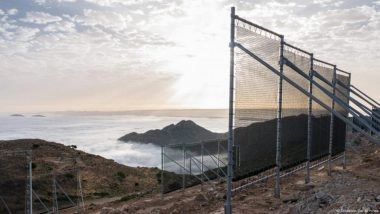
Fog is a cheap and abundant source of fresh water, especially in remote dry regions. And it also has great potential for cities. How fog collection works and where it is already being used.Sitting on the fringes of the Moroccan desert, the mountainous region of Ait Baamrane receives little rainfall. But what it does get in abundance, and for six months of the year, is dense fog sweeping in from the nearby Atlantic.
Also Read | Latest News | 15 Patients Report ‘mild Reactions’ After Use of IV Fluid at Hospital in Punjab’s Sangrur.
While it might restrict visibility, this misty mass also provides a solution to water shortages. How? It is harvested in the world's largest fog collection system.
Also Read | Entertainment News | Kajol, Chiranjeevi and Others Send Birthday Wishes to Aamir Khan as He Turns 60.
How does fog harvesting work?
The wind pushes water vapor in the air through vertical nets, where it condenses into small droplets that trickle down the netting to be gathered in large containers. The nets collect around 35,000 liters of water every day, which covers the needs of more than 1,000 people and is also used to irrigate plants.
Fog is not only collected in Morocco's mountains but in other places including Ghana, Eritrea, Ethiopia, Chile, California and South Africa. The global potential is huge with suitable locations almost everywhere, especially along coastlines.
Depending on the location, a 40-square-metre (450-square-mile) fog net provides around 200 liters per day. Each one costs around $1,500 (€1,628).
Can urban areas also benefit?
Until now, fog collection has mainly been seen as a solution for remote rural areas where people are barely connected to the public water network or infrastructure.
However, a study recently published in the scientific journal Frontiers in Environmental Science, shows that the technology could also benefit cities.
With less than one millimeter of rainfall per year, the Atacama Desert in northern Chile is one of the driest places in the world. Cities in the region rely heavily on water from deep underground aquifers that were last replenished between 10,000 and 17,000 years ago. As these ancient supplies are not inexhaustible and because refreshing them takes a very long time, alternative sources are vital.
In the town of Alto Hospicio, which lies on the edge of the desert, many of the approximately 10,000 inhabitants live in poverty. Unconnected to the public water network, they rely on trucks to bring supplies to the slums.
In search of a solution to the city's water shortage problems, researchers experimented with fog nets both in the urban area and on surrounding hills. On some days they were able to collect as much as 10 liters per square meter, which they say is enough to cover the human consumption and irrigation needs of populations lacking access to public source water.
Meeting the water needs of slums with fog
According to the researchers, an average of 2.5 liters of water could be harvested per day and square meter. Using 17,000 square meters of netting, the size of around two and a half soccer pitches, would make it possible to cover the entire water requirements of the slums of Alto Hospicio.
110 square meters of net would be enough to irrigate the city's entire green spaces all year round.
Water obtained in this way could be transported further via pipes or by truck. However, as the fog only supplies water for a few months of the year, other sources have to be used in the summer.
This article was adapted from German.
(The above story first appeared on LatestLY on Mar 14, 2025 06:40 PM IST. For more news and updates on politics, world, sports, entertainment and lifestyle, log on to our website latestly.com).
 Share Now
 Google Trends



 Live Bot